How to Evaluate Your Google Ads Agency: 8 Key Performance Criteria
Contents
- 1. Is Conversion Tracking Accurate and Trustworthy?
- 2. Do Advertising Results Match Business Objectives?
- 3. Is the Agency Allocating Budget Intelligently?
- 4. Is Optimization Meaningful Rather Than Merely Frequent?
- 5. Does the Agency Interpret Performance Trends Correctly?
- 6. Is Reporting Transparent and Decision-Oriented?
- 7. Does the Agency Provide Strategic Recommendations?
- 8. Are Communication, Account Access and Collaboration Healthy?
- How Often Should You Review Your Google Ads Agency?
- Common Mistakes When Assessing PPC Agency Performance
- When Should You Consider Switching Google Ads Agencies?
- Eight-Point PPC Agency Evaluation Checklist
- Frequently Asked Questions
- Conclusion: Evaluate the Whole Relationship, Not One Number
Introduction
How can you tell whether your Google Ads agency is doing a good job? Start by asking whether the account’s reported performance is producing the business outcomes you hired the agency to achieve. An ecommerce advertiser may see an impressive return on ad spend while struggling with thin product margins. A lead-generation business may celebrate cheaper form submissions even as its sales team reports fewer qualified prospects. In both cases, the advertising dashboard can look healthy while the commercial picture is less convincing.
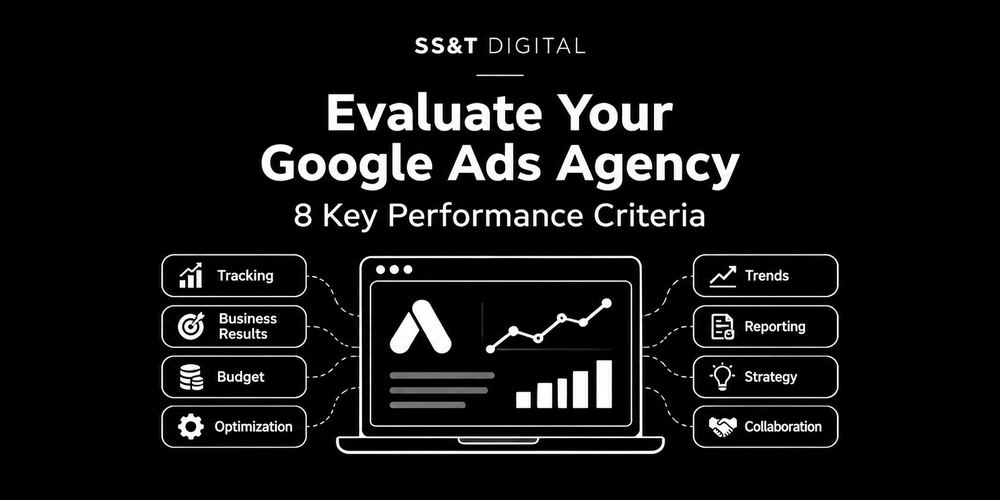
A fair agency review looks beyond a single KPI. It examines conversion measurement, commercial outcomes, budget allocation, optimization decisions, the interpretation of recent trends, reporting quality, strategic advice and the way the agency works with your team. It also distinguishes what the agency controls from factors such as pricing, inventory, website performance and sales follow-up. These eight criteria provide a practical framework for reviewing an existing partner or setting expectations before a new engagement.
1. Is Conversion Tracking Accurate and Trustworthy?
Before judging performance, establish exactly what a reported conversion represents. A form submission, a phone call, an add-to-cart event and a completed purchase are not interchangeable outcomes. Ask your agency to show which conversion actions are recorded, which ones influence bidding and whether the same business event might be counted twice. A campaign optimized toward a low-value interaction can report improving conversion volume without generating more revenue or qualified opportunities.
In Google Ads, primary conversion actions generally feed the “Conversions” column and bidding when their standard conversion goal is selected for the campaign. Secondary actions are normally observed in “All conversions.” There is an important exception: actions included in a custom goal can be used for bidding even when labeled secondary. An agency should therefore review the campaign’s actual conversion goals, not merely point to the primary/secondary labels. Google’s official explanation is available at https://support.google.com/google-ads/answer/10995103 .
Google Ads, GA4 and a company’s CRM may report different totals for legitimate reasons. They can use different attribution rules, dates, data-processing schedules and scopes. But legitimate discrepancies are not an excuse to avoid investigation. The agency should check tag firing, transaction IDs, duplicate events, consent effects and the way conversions are imported or attributed. It should explain what can and cannot be reconciled with order or CRM records.
Why qualified leads matter more than raw forms
Imagine a professional-services firm generating many inexpensive contact forms. If most inquiries are irrelevant, the campaign may be optimizing toward an easy action rather than valuable demand. Linking appropriate CRM stages to offline conversion measurement can help the agency assess which campaigns produce sales-qualified opportunities. Enhanced conversions for leads may improve matching where implementation and privacy requirements are met, but the quality of the underlying CRM data still matters. Google’s implementation checklist is at https://support.google.com/google-ads/answer/16782203 .
Conversion lag is another essential consideration. A user may click an ad today and convert days later, meaning the most recent dates are incomplete. Your agency should account for this before declaring a sudden decline or making a major budget decision. Google explains how to inspect conversion lag at https://support.google.com/google-ads/answer/9347065 .
2. Do Advertising Results Match Business Objectives?
The right performance indicators depend on how your business makes money. An ecommerce retailer may examine conversion value, return on ad spend, order volume and contribution margin. A B2B company may care more about qualified leads, opportunities created, sales-cycle progression and customer acquisition cost. CPA and CPL are useful efficiency measures, but they should be connected to what happens after the initial conversion.
Consider a hypothetical retailer spending $10,000 on Google Ads and recording $50,000 in attributed revenue. Its ROAS is 5.0. If the products have a 25% contribution margin before advertising, the contribution is $12,500; subtracting the $10,000 ad spend leaves $2,500 before any additional expenses not already included in that margin. Returns or other costs could erase much of that amount. The agency has not necessarily failed, but reporting ROAS without commercial context would leave an important question unanswered. These figures are illustrative, not market benchmarks or client results.
Lead generation has a similar trap. Suppose CPL falls from $100 to $60, but the proportion of leads accepted as qualified drops from 40% to 10%. The effective cost per qualified lead rises from $250 to $600. The agency should investigate search intent, ad promises, landing-page messaging and CRM feedback rather than simply presenting the lower CPL as a success. When calculating CAC, clarify whether the figure includes only media spend or also sales and other acquisition costs.
Your agency should agree on a hierarchy of metrics with you. Leading indicators such as clicks and conversion rate help diagnose performance, while qualified revenue, profitable orders or accepted opportunities determine whether the activity serves the business. A campaign can perform well on one level and poorly on another; the review should make that distinction visible.
3. Is the Agency Allocating Budget Intelligently?
Spending the entire monthly budget is not proof of effectiveness. Nor is underspending automatically evidence of poor management. The question is whether the agency can explain why money is allocated to particular campaigns, products, locations or stages of demand, and whether additional spend is likely to generate valuable incremental outcomes.
For Search campaigns, impression share provides context about the proportion of eligible impressions received. Search Lost IS (budget) and Search Lost IS (rank) can help distinguish limitations associated with budget and Ad Rank. A high lost impression share due to budget does not automatically mean the business should spend more. The agency should first consider whether the additional auctions are likely to deliver conversions at an acceptable marginal cost. Google’s overview is at https://support.google.com/google-ads/answer/6165454 .
Ask for the reasoning behind budget increases and cuts. Was a campaign scaled because conversion volume was stable and marginal efficiency remained acceptable? Was spend reduced because lead quality deteriorated, inventory changed or the account was prioritizing a more profitable product category? In some situations, maintaining the current allocation while waiting for more reliable data is the responsible choice. Good budget management is evident in documented decisions and their measured consequences.
4. Is Optimization Meaningful Rather Than Merely Frequent?
An active change log does not automatically indicate a strong optimization process. Constantly adjusting bid targets, budgets and campaign structure can make performance harder to interpret, particularly when conversion volume is low. At times, leaving a campaign unchanged while data accumulates is a deliberate and defensible decision. Your agency should be able to describe the hypothesis behind an action, what changed and when its effect will be reviewed.
For Search, relevant work may include analyzing search terms, identifying genuinely irrelevant queries for negative keywords, testing ad copy and evaluating the relationship between queries and landing pages. For automated bidding, the agency should assess whether target CPA or target ROAS reflects current business economics and available conversion data. For Performance Max, review the quality of assets, conversion goals, product segmentation where appropriate and Merchant Center feed health. Not every campaign offers identical reporting or controls, so expect an explanation of what can be verified rather than a generic checklist.
Landing-page quality belongs in the conversation as well. A campaign can attract relevant users while an unclear offer, slow page or cumbersome form prevents them from converting. The agency may not own the website, but it should flag likely bottlenecks and coordinate recommendations with the team responsible for implementation. Google Ads Change history can help verify when account changes occurred; a separate action log explaining the business rationale makes those records much more useful.
5. Does the Agency Interpret Performance Trends Correctly?
Reviewing the last 30, 14 and 7 days can help separate the broader trend from recent movement. However, those windows overlap: the last seven days are contained within the last fourteen and thirty. They are not three independent samples. For cleaner comparisons, the agency may also need equal-length non-overlapping periods, day-of-week context and a timeline of significant account changes.
Imagine a campaign whose CPA deteriorates over the latest seven days but remains near target over thirty days. An inexperienced response might be to pause the campaign immediately. A more disciplined review would check conversion lag, recent click and conversion volumes, changes to bidding or landing pages, seasonal demand and any measurement issues. With only a few conversions, one delayed sale can materially change the weekly CPA. The reverse is also true: two exceptionally good days rarely justify a dramatic budget increase on their own.
Google documents several reasons Search performance can fluctuate, including bidding targets, budget limitations, auction dynamics, conversion delays and account changes. Its October 2026 documentation also describes bidding-system changes beginning in August 2026 that can cause temporary fluctuations in budget-limited target-based strategies. The agency should use current platform guidance without treating every fluctuation as an algorithm issue. Reference: https://support.google.com/google-ads/answer/12266223 .
The standard should be thoughtful interpretation, not perfect prediction. A capable agency will say when evidence is inconclusive, identify what additional data would resolve the question and explain why it is choosing to act or wait.
6. Is Reporting Transparent and Decision-Oriented?
A useful agency report should show spend, conversions, CPA, ROAS and conversion value where relevant, broken down by campaign and compared with meaningful targets. It should distinguish platform-attributed results from actual orders, CRM-qualified leads or recognized revenue when those data sources are available. Most importantly, it should explain the changes behind the numbers and what the team plans to do next.
Consider an agency that sends a polished dashboard every month but never explains why lead quality has fallen or what tests it recommends. The reporting cadence may be reliable, yet the business receives little strategic value. A better review connects each material change to evidence, a plausible cause, a proposed action and a date for reassessment. The agency should be equally willing to discuss underperformance and positive results.
You should also be able to access the underlying account and reports at an appropriate permission level. If the only evidence of performance is a selection of screenshots provided by the agency, independent review becomes difficult. Clear definitions, consistent date ranges and visibility into material changes make the relationship more accountable.
7. Does the Agency Provide Strategic Recommendations?
An experienced PPC partner should notice opportunities and constraints beyond the bidding interface. For ecommerce, that may involve inventory, product feed quality, pricing competitiveness or the contribution margin of different categories. For lead generation, it may involve form friction, the quality of sales follow-up, CRM stages or differences between locations and service lines. These factors influence paid media performance even when the agency does not control them directly.
Suppose a campaign attracts relevant searches but produces few qualified inquiries. A strategic agency should consider whether the ad sets unrealistic expectations, whether the landing page explains the service clearly and whether the sales team is rejecting leads for reasons that can inform targeting. The website and sales processes may belong to other teams, but identifying a likely constraint and proposing a collaborative test is valuable.
Strategic advice does not always mean launching more campaigns. It may involve simplifying conversion goals, excluding low-margin inventory, improving measurement before scaling or shifting budget toward better-qualified demand. Recommendations should specify the business rationale, the team responsible for implementation and how the outcome will be evaluated.
8. Are Communication, Account Access and Collaboration Healthy?
Performance management requires a working relationship in which responsibilities are clear. Know who manages the account, who approves major changes, how often the agency reviews performance with you and what happens when an urgent issue appears. Weekly meetings are not mandatory for every advertiser, but regular, intelligible communication and a reliable escalation path are important.
Google Ads manager accounts can allow agencies to work with advertiser accounts through linked access. Your company should understand its own account access, administrative responsibilities, billing arrangements and how the relationship would be unwound if needed. Permissions can be limited for security, but the advertiser should not be left unable to inspect its own campaign history or verify its advertising investment.
Ask for an action log or equivalent documentation covering significant budget, bidding and structural decisions. That record helps both parties understand which changes were implemented, which were proposed but not approved and what happened afterward. It also prevents disagreements from relying on incomplete memories of meetings.
How Often Should You Review Your Google Ads Agency?
Daily monitoring can catch urgent delivery problems, unexpected spending or broken conversion measurement. Weekly reviews are useful for examining recent changes, search-term quality and budget pacing. Monthly or longer-cycle discussions are often better suited to commercial outcomes, lead quality, profitability and strategic priorities. The right cadence depends on spend, risk, conversion volume and the speed of the sales cycle.
High-volume accounts may generate enough data to support frequent decisions. Accounts with few monthly conversions require more patience and greater attention to uncertainty. A good agency should explain why it has chosen its monitoring and review rhythm instead of equating more changes with better management.
Common Mistakes When Assessing PPC Agency Performance
Click volume and CTR can help diagnose how ads attract attention, but neither proves that profitable customers were acquired. Similarly, a low CPA may be misleading if it measures low-quality forms, and a high ROAS does not automatically imply strong margins. Evaluating reported results without validating tracking or attribution can produce false confidence.
Other common mistakes include reacting to a single bad week, treating every optimization as beneficial simply because it was made and ignoring factors controlled by the advertiser. Pricing, inventory, website usability and sales follow-up can change outcomes materially. A fair review assigns accountability without pretending the agency controls the entire business.
When Should You Consider Switching Google Ads Agencies?
Persistent unexplained declines, unreliable tracking, missing reports, repeated communication failures and a refusal to explain optimization decisions are legitimate warning signs. Restricted account access or a strategy that remains disconnected from business objectives also deserves attention. A single difficult month, however, is rarely enough evidence by itself.
Before making a change, request a structured performance review. Compare Google Ads data with CRM or order outcomes, document tracking concerns, identify external constraints and review the decisions made so far. Agree on specific corrective actions, owners and a date to reassess. If the problems remain and the agency cannot provide a credible plan or transparent explanation, an independent audit or partner change may be appropriate. During a transition, preserve account history, tracking configuration and access continuity.
Eight-Point PPC Agency Evaluation Checklist
1. Measurement: Are the conversion goals correct, and can discrepancies with sales or CRM records be explained?
2. Business outcomes: Do reports connect CPA and ROAS to qualified leads, revenue and profitability?
3. Budget: Are increases, cuts and campaign priorities supported by evidence?
4. Optimization: Can the agency explain why it made each material change and when it will measure the result?
5. Analysis: Are overlapping 30/14/7-day windows and conversion lag interpreted appropriately?
6. Reporting: Are results, problems, actions and next steps transparent?
7. Strategy: Does the team identify website, feed, product and sales-process constraints?
8. Collaboration: Are account access, responsibilities and communication expectations clear?
Frequently Asked Questions
How do I know whether my Google Ads agency is performing well?
Look for reliable measurement, business-relevant outcomes, thoughtful budget and optimization decisions, transparent reporting and clear communication.
Which KPIs should I use to evaluate a PPC agency?
Use metrics appropriate to your business, such as CPA, CPL, ROAS, qualified opportunities, revenue, CAC and profitability. Clicks and CTR are supporting diagnostics.
What should a good Google Ads agency report include?
It should compare campaign results with objectives, explain important changes, document actions and provide concrete next steps rather than simply export a dashboard.
How frequently should a Google Ads agency optimize campaigns?
There is no universal change frequency. Decisions should reflect data volume, risk and campaign learning rather than a requirement to edit something every day.
Does a high ROAS mean my agency is successful?
Not necessarily. ROAS measures attributed revenue relative to advertising spend; it does not account for all business costs or guarantee profit.
Why can Google Ads conversions rise while sales stay flat?
The tracked action may be a lead rather than a sale, lead quality may decline, attribution may differ or the sales process may convert fewer prospects.
When should I switch Google Ads agencies?
Consider a change when material problems persist despite a documented review and reasonable corrective plan, especially if measurement or transparency remains unreliable.
Should I have access to my Google Ads account?
Your business should retain appropriate visibility and administrative continuity. Access roles should be managed securely and clearly documented.
How can I check what my agency changed?
Google Ads Change history provides a record of account changes for authorized users. Ask the agency to connect significant changes to the reasons and expected outcomes.
Conclusion: Evaluate the Whole Relationship, Not One Number
A strong Google Ads agency should be assessed through the quality of its measurement, commercial outcomes, budget decisions, optimization, analysis, reporting, strategy and collaboration. The point is not to demand perfect results every week; it is to establish whether your partner can explain what is happening, take responsibility for its decisions and improve the account in a way that serves your business. SS&T Digital approaches performance marketing strategically, sustainably and tactically, with a focus on transparent reporting and business-aligned decisions. To discuss your Google Ads account and potential improvement opportunities, visit https://www.ssandtdigital.com/ .