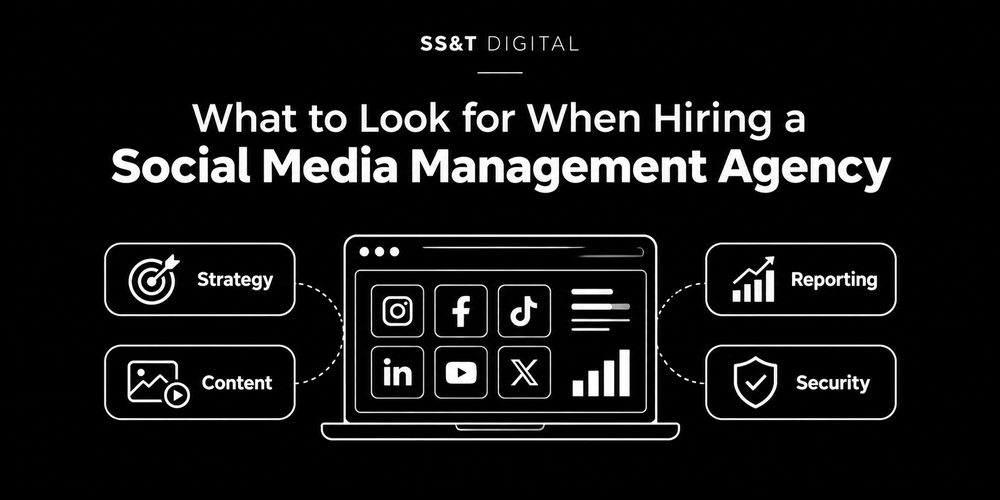
What to Look for When Hiring a Social Media Management Agency
Contents
- What Do Social Media Management Services Include?
- Define Your Business Goals Before Choosing an Agency
- How Well Does the Agency Understand Your Audience and Industry?
- How to Evaluate Content Strategy and Creative Quality
- Which Social Media Platforms Should Your Business Prioritize?
- Organic Social Media Management vs Paid Social Advertising
- How Should Social Media Performance Be Measured?
- What Should Be in an Agency’s Monthly Report?
- What Should the Working Process Look Like?
- What to Check in a Social Media Management Proposal
- Account Access, Security and Content Ownership
- Common Mistakes When Hiring a Social Media Agency
- Ten Questions to Ask Before Hiring a Social Media Management Agency
- Frequently Asked Questions
- Conclusion: How to Choose the Right Social Media Management Partner
Introduction
Hiring a social media management agency starts with a business decision, not a content calendar. Before you compare portfolios or monthly posting commitments, decide what your social channels need to accomplish. A local service business may want to build trust and answer customer questions, while a B2B company might use LinkedIn to demonstrate expertise and support a longer sales process. An ecommerce brand may need a steady supply of product videos that work across organic channels and paid campaigns. Those are different assignments, even if every proposal calls the service “social media management.”
A strong partner should be able to explain how it will understand your audience, turn business priorities into an achievable content plan, produce and approve creative, report meaningful outcomes and protect your accounts. This guide explains how to evaluate those capabilities, compare proposals on equal terms and build a working relationship that remains practical after the contract is signed.
What Do Social Media Management Services Include?
Social media management services generally bring together strategy, content planning, creative production, publishing, audience engagement and performance review. The exact combination varies. One provider may focus on scheduling content supplied by your team, while another handles original photography, short-form video, copywriting, community moderation and monthly strategic reviews. The phrase “full service” is not a substitute for an itemized scope.
Strategy establishes who the content is for, what the brand wants to communicate and how each platform contributes. An editorial calendar turns that direction into a publishing plan. Designers, writers and video producers create the assets; account managers coordinate approvals and scheduling. Community support may involve monitoring comments, responding to direct messages and escalating customer questions. Reporting should connect the work to business priorities and explain what will change in the next cycle.
Content planning and production
Ask how many deliverables are genuinely original and how many are adaptations of existing assets. Twelve posts could mean twelve unique concepts or a smaller number of designs repurposed across platforms. A short video edited from footage your team provides is different from a video requiring scripts, filming, lighting and post-production. Understanding the workflow helps you compare providers without relying on headline post counts.
Community management and reporting
Posting content does not necessarily mean that the agency will answer customer messages. If your brand receives product questions, booking requests or complaints, define response windows, escalation rules and the boundary between marketing and customer service. Reporting also varies: a dashboard showing impressions is useful, but it should not replace an explanation of why performance changed and which experiments the team recommends next.
Define Your Business Goals Before Choosing an Agency
Your goals determine what content you need and how success should be assessed. Brand awareness might call for broad but relevant reach, recognizable creative and consistent messaging. A company looking to build a community may prioritize conversations and returning participants. A lead-generation business might focus on qualified site visits and inquiries. A retailer could examine product discovery, traffic and sales contribution while remembering that social content may influence decisions that happen later through another channel.
Avoid turning every organic post into a direct-response sales test. Educational content can build familiarity and answer objections long before someone submits a form or places an order. That does not make it unmeasurable; it means the measurement framework should reflect the role of the content. An agency that asks about your sales cycle, customers and existing analytics before proposing KPIs is more likely to design a relevant program.
Example: A local service business
Imagine an independent neighborhood fitness studio seeking help with Instagram and Facebook. Its audience may value class schedules, instructor introductions, short exercise demonstrations and authentic customer stories. The studio could provide photos from its own sessions while an agency develops the calendar, edits short clips and keeps the accounts consistent. If customers routinely ask about trial classes, someone must own those messages. A daily professional film shoot or a presence on six platforms may be unnecessary. This is an illustrative example, not a universal platform recommendation.
How Well Does the Agency Understand Your Audience and Industry?
Relevant experience is useful, but previous work in your exact sector should not be a mandatory requirement. What matters more is whether the team can investigate your customers, understand the buying journey and learn the language of your business. Ask what research the agency performs before building a calendar. Does it review your existing content and analytics, interview stakeholders, examine competitor positioning and identify unanswered customer questions?
An agency should use competitor research to find opportunities rather than reproduce another brand’s posts. It should also distinguish between business models. A consumer lifestyle brand may benefit from visual demonstrations and frequent short videos, while an enterprise software provider may need carefully researched explanations and customer proof. These differences should influence channel selection, creative tone and the way results are reported.
How to Evaluate Content Strategy and Creative Quality
An editorial calendar is only as good as the thinking behind it. Look for a clear mix of educational material, useful product or service information, customer questions, brand stories and timely announcements. A proposal promising a high posting frequency can still underperform if every post repeats the same message. The right content mix depends on audience needs and your team’s ability to supply reliable information.
Review portfolio samples beyond their visual polish. Does the copy explain something useful? Are videos easy to follow without sound? Is the tone appropriate for the audience? Do different formats serve different purposes, or does every brand receive the same template? Consistent design helps recognition, but consistency should not eliminate variety or clarity.
Video and AI-assisted production
Short-form video can be valuable when it makes a product easier to understand, demonstrates expertise or communicates a story efficiently. The agency should explain who develops concepts, writes scripts, films, edits, captions and approves the work. AI tools may help with ideation, transcripts or production tasks, but they do not remove the need for fact-checking, brand review and responsible use of licensed or third-party assets.
Which Social Media Platforms Should Your Business Prioritize?
Instagram can support visual storytelling, product demonstrations and Reels. Facebook may remain relevant for local communities, events and customer communication. TikTok can suit brands able to create platform-native short videos consistently. LinkedIn often makes sense for professional audiences, hiring and B2B expertise. YouTube supports longer educational videos alongside Shorts, while X can serve timely commentary and community communication when the audience is active there.
The right channel mix is not a popularity contest. Ask where your buyers spend attention, what they expect from brands there and whether you can sustain appropriate content. It is often more productive to operate two channels thoughtfully than to spread the same generic content across every available platform.
Example: A B2B software company
Consider a cybersecurity software company that wants to reach IT leaders. LinkedIn content could explain common implementation challenges, interpret relevant industry developments and share credible product use cases. The company might publish fewer but more researched posts, supported by expert interviews. Instead of evaluating success solely by follower growth, it could track engagement from relevant audiences, visits to educational resources and qualified conversations over time. The long buying cycle means a post that generates no immediate sale is not necessarily ineffective.
Organic Social Media Management vs Paid Social Advertising
Organic management covers the brand’s own content, publishing and community presence. Paid social advertising on Meta Ads, TikTok Ads or LinkedIn Ads requires campaign objectives, budget allocation, targeting, bidding, tracking, creative testing and optimization. A provider that publishes Instagram posts is not automatically managing your Meta advertising account. Request a clear separation of responsibilities, fees and media spend.
The teams can still learn from each other. Questions appearing in organic comments may inspire advertising messages, while paid creative tests can reveal which product benefits resonate. However, organic reach and engagement should not be combined indiscriminately with conversions attributed by ad platforms. Their definitions, attribution rules and business meanings differ.
Example: An ecommerce brand
A growing skincare retailer might publish product demonstrations and customer education on Instagram and TikTok while testing multiple video hooks in Meta Ads. The organic team can identify recurring questions and produce authentic product explanations; the advertising team can test variations and examine acquisition efficiency. The shared creative process can improve learning, but commercial decisions still need conversion tracking, sales value, margins and an awareness of attribution differences. This example is hypothetical and does not describe a client engagement.
How Should Social Media Performance Be Measured?
Reach generally describes the number of distinct accounts exposed to content, while impressions count displays or views under platform-specific definitions. Engagement includes interactions such as comments, reactions, saves and shares, but the exact available metrics vary by platform. Engagement rate is not a single universal formula: it may be calculated using reach, impressions or followers as the denominator. A report should state which definition it uses before comparing periods or channels.
Follower growth can indicate audience development, but raw volume does not establish relevance. Video views and watch time help evaluate content consumption, although view thresholds and playback definitions differ. Profile visits and link clicks suggest interest; website sessions and conversions describe subsequent behavior that requires separate analytics. An agency should avoid treating a like, a click and a sale as equivalent outcomes.
For web traffic, consistent UTM parameters can help identify social campaigns in Google Analytics 4. Google’s documentation describes utm_source, utm_medium and utm_campaign for campaign tagging. Agree on a naming convention for organic and paid links and inspect GA4 traffic acquisition reports. Click counts on a social platform may not match GA4 sessions because of measurement, consent and user behavior differences; UTM tags do not guarantee perfect sales attribution.
A B2B company may care about qualified inquiries and engagement from decision-makers, while a consumer brand may emphasize discovery, repeat attention and site visits. Good reporting prioritizes a manageable set of metrics that can inform decisions rather than presenting every available number with equal weight.
What Should Be in an Agency’s Monthly Report?
The report should begin with objectives and work completed during the period. It can then compare results with an appropriate previous period, review individual content performance, identify standout posts and explain what needs improvement. Audience insights, relevant website behavior and any changes to publishing volume or measurement methods provide important context.
Interpretation is the difference between reporting and simply exporting a dashboard. If reach increases but qualified site traffic falls, the agency should investigate the content’s audience, message and calls to action rather than celebrating the reach number alone. Useful reports close with specific experiments or changes, the reason for each action and a date for reviewing results.
What Should the Working Process Look Like?
Many engagements start with a discovery conversation, account audit and review of available brand assets. The agency then proposes objectives, channel priorities and an initial content plan. Creative production, stakeholder approval, publishing and performance review follow in a recurring cycle. This is a practical pattern, not a mandatory sequence for every business or agency.
Agree on who supplies product information, who approves claims and creative, and how quickly feedback should be provided. A single accountable approver can reduce delays. Define how urgent announcements, unexpected complaints and campaign changes are handled. Regular meetings should have a purpose, such as reviewing results and making decisions, rather than simply confirming that posts were published.
What to Check in a Social Media Management Proposal
Two agencies can promise the same number of posts while offering very different services. One might produce original videos with on-site filming; another may edit clips supplied by the client. One may answer comments and messages; another may only schedule posts. Before discussing which proposal offers better value, put the deliverables, responsibilities and exclusions side by side.
The comparison table below is designed to help a marketing manager evaluate two proposals using the same criteria. Adapt it to your business and ask providers to clarify any vague items before signing.
| Criterion | Agency A | Agency B |
|---|---|---|
| Platforms | List channels | List channels |
| Original content | Number/format | Number/format |
| Video and Reels | Filming/editing | Filming/editing |
| Photography | Location/days | Location/days |
| Copywriting | Included/separate | Included/separate |
| Content approvals | Process/deadline | Process/deadline |
| Community management | Response windows | Response windows |
| Revisions | Rounds included | Rounds included |
| Reporting | KPIs/frequency | KPIs/frequency |
| Paid advertising | Included/separate | Included/separate |
| Contract | Term/exit | Term/exit |
| Additional services | Exclusions | Exclusions |
Account Access, Security and Content Ownership
Your business should retain ownership and appropriate administrative control of its social accounts. Rather than sharing personal passwords, use the role and access tools supported by each platform. LinkedIn documents different Page admin roles, including super admin and content admin; Meta distinguishes types of Page access and control. Grant only the permissions needed for the work, review them periodically and enable multi-factor authentication wherever available.
Clarify who owns the finished creative, whether editable design files and raw footage are delivered, and which third-party assets are licensed for continued use. Agree on an offboarding process so former partners’ access can be removed and content files transferred when the engagement ends. Contract and intellectual-property requirements differ by jurisdiction; obtain appropriate legal advice for specific agreements.
Common Mistakes When Hiring a Social Media Agency
A frequent mistake is choosing solely by posting volume or attractive portfolio designs. Without clear goals, even polished content can become repetitive and disconnected from business outcomes. Other risks include expecting one provider to deliver strategy, filming, community moderation and paid advertising without verifying the scope, or assuming every social channel deserves the same content.
Be cautious about guaranteed organic follower growth or sales promises that lack credible conditions. Do not overlook reporting methods, approval responsibilities, account access or content ownership. These issues can create larger operational problems than an imperfect content calendar.
Ten Questions to Ask Before Hiring a Social Media Management Agency
1. How will you learn about our customers and business goals?
The answer reveals whether the team begins with discovery and evidence or applies a generic publishing template.
2. Which platforms would you prioritize, and why?
Look for reasoning based on your audience and production capacity, not a default recommendation to use every channel.
3. How do you define original posts, repurposed content and videos?
Clear definitions prevent misunderstandings about deliverables and production workload.
4. Who writes, designs, films, edits and approves the content?
Understanding responsibilities helps you estimate the work that remains with your internal team.
5. Who responds to comments and direct messages?
Ask about response windows, escalation rules and coordination with customer support.
6. Is paid advertising management included or separate?
Clarify campaign responsibilities, creative testing, advertising budgets and account access.
7. Which KPIs will you report, and how will they relate to our goals?
A useful answer should connect metrics to decisions and explain how progress is reviewed.
8. How do you manage approvals and urgent changes?
The process should be realistic for your team’s availability and the pace of your business.
9. How will account permissions and content rights be handled?
This protects continuity, security and access to creative assets after the engagement.
10. What will you review after the first reporting period?
Look for a learning plan, not a promise that every result will improve immediately.
Frequently Asked Questions
What do social media management services include?
They can include strategy, planning, writing, design, video, publishing, community engagement and reporting. The exact services should be specified in the proposal.
Do I need an agency to manage social media?
Not necessarily. An in-house employee or freelancer may be appropriate for a limited scope. An agency can help when multiple skills or channels are needed.
Is social media management the same as paid advertising?
No. Organic content management and paid campaign optimization involve different tasks, although they can share creative insights and planning.
What should I look for in a social media agency?
Evaluate audience understanding, strategy, creative quality, reporting, communication, security and clearly defined deliverables.
How do I measure the success of social media management?
Choose metrics based on goals, such as relevant reach, meaningful engagement, website traffic or qualified inquiries. No single KPI fits every business.
Will an agency create original content?
Some will, but original design, filming, editing and copywriting should be explicitly described in the scope.
How long does social media management take to show results?
It depends on the goals, existing account, market and content quality. Early reporting often focuses on establishing a baseline and learning what resonates.
Which social media platforms should a business use?
Prioritize platforms where the intended audience is active and the business can produce useful content consistently.
Conclusion: How to Choose the Right Social Media Management Partner
The right agency is not necessarily the one promising the most posts or the broadest list of platforms. It is the team that understands what your business needs, defines a realistic scope, produces relevant content, communicates clearly and uses reporting to improve decisions. Compare proposals on deliverables, measurement, working process and account security before committing. At SS&T Digital, we approach social media work strategically, sustainably and tactically, with attention to measurable business objectives. To discuss the services that fit your organization, visit https://www.ssandtdigital.com/ .