Meta Ads CBO vs. ABO: Campaign Budget or Ad Set Budget?
Contents
- What Is CBO in Meta Ads?
- What Is ABO in Meta Ads?
- CBO vs ABO: Key Differences
- When Should You Use CBO?
- When Should You Use ABO?
- CBO or ABO for Audience and Creative Testing?
- CBO or ABO for Scaling Campaigns?
- Why Does CBO Favor Certain Ad Sets?
- How to Optimize an ABO Campaign
- A $300 Daily Budget: CBO vs ABO Example
- CBO vs ABO for Ecommerce
- CBO vs ABO for Lead Generation
- What About Small Budgets?
- Common CBO and ABO Mistakes
- Decision Matrix: Which Budget Structure Fits?
- Frequently Asked Questions
- Conclusion: Which Budget Approach Is Right for Your Business?
Introduction
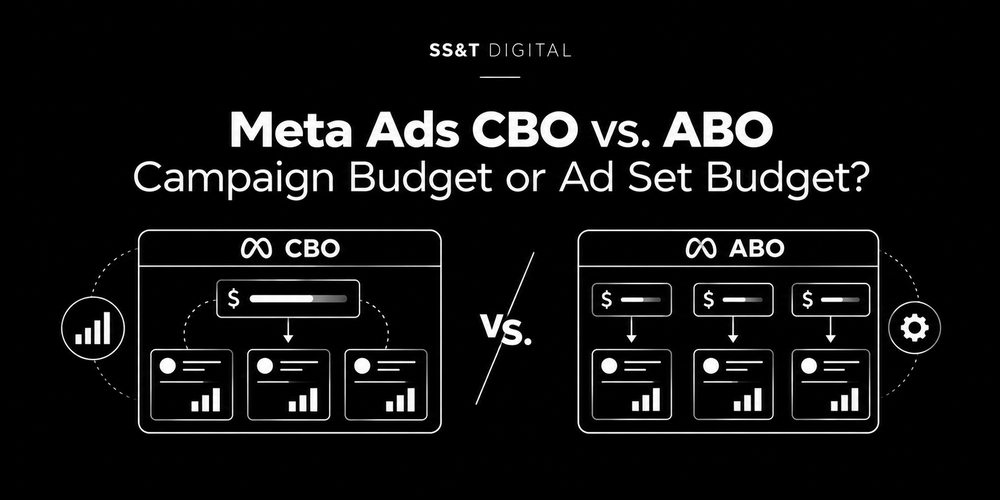
Should you place your Meta Ads budget at campaign level or assign a separate amount to each ad set? The choice determines who controls the allocation of spend. With CBO, you provide one campaign budget and Meta distributes it among eligible ad sets based on the opportunities its delivery system predicts. With ABO, you decide the budget for each ad set. If you need every new audience to receive a meaningful amount of spend, ad set budgets may give you more control. If several ad sets are pursuing the same business outcome and you care primarily about campaign-wide results, a campaign budget may be more efficient to manage. Neither setting guarantees a lower CPA or higher ROAS.
The most useful question is not which acronym is better. Ask what the campaign is designed to accomplish. Are you gathering evidence about different audiences, trying to scale proven demand, or protecting a fixed allocation for different markets? Those are different jobs. A well-run account may use both approaches at the same time, because the right amount of automation depends on the decision the advertiser needs to make.
What Is CBO in Meta Ads?
CBO stands for Campaign Budget Optimization, a term advertisers still use widely. Meta’s current product language may refer to the setting as Advantage+ campaign budget. Rather than allocating a separate daily or lifetime budget to every ad set, you establish one campaign budget. Meta can then shift delivery toward ad sets where it expects more favorable opportunities to achieve the campaign objective. Three ad sets do not automatically receive one-third of the spend each.
This flexibility can be valuable when ad sets pursue the same optimization event and conversions have broadly similar economic value. Consider an ecommerce campaign selling one product range to several prospecting audiences. If the business objective is total profitable purchases, forcing equal spend may not be useful. On the other hand, if a region must receive a committed amount for commercial reasons, automatic distribution may conflict with that requirement. Eligible ad set spending limits can offer additional control, but they should not be treated as a universal equal-allocation switch.
What Is ABO in Meta Ads?
ABO is the industry abbreviation for Ad Set Budget Optimization. In Ads Manager, this generally means using ad set budgets; do not assume there is a standalone product labeled ‘ABO.’ Each ad set has its own budget, so the advertiser decides how much spending capacity it receives. This can make reporting and planning easier when audiences, markets or services need separate allocations.
Imagine three regions with distinct sales teams. An ad set budget allows each region to maintain its planned spend even when another region has a better short-term CPA. The trade-off is that a weak ad set can continue spending its allocation while a stronger one remains constrained. ABO does not automatically optimize the overall distribution for you. It also does not force equal delivery between ads inside the same ad set; creative-level delivery still responds to Meta’s optimization system.
CBO vs ABO: Key Differences
Campaign budgets and ad set budgets are not competing algorithms that make every other campaign setting irrelevant. The difference is the level at which spend is controlled. CBO offers more flexibility to move money between ad sets. ABO makes the advertiser responsible for choosing and revisiting those allocations. In both cases, conversion quality, creative strength, audience relevance, attribution and bidding affect results.
A useful comparison should cover budget location, allocation authority, automation, control over each ad set, suitability for structured testing, scaling flexibility, learning volume, and performance reporting. Those dimensions matter more than a blanket recommendation to always test with one structure and scale with the other.
| Criterion | CBO | ABO |
|---|---|---|
| Budget location | Campaign | Ad set |
| Allocation control | Meta delivery | Advertiser |
| Automation | High | Manual set budgets |
| Ad set control | Limited / eligible limits | Direct |
| Audience testing | Uneven allocation possible | Planned spend |
| Scaling | Shared-budget flexibility | Ad set-level changes |
| Conversion volume | Flexible across ad sets | Can be fragmented |
| Audience comparison | Some sets may underspend | Defined observation budget |
| Learning | Sensitive to major edits | Sensitive to major edits |
| Budget flexibility | Automated across sets | Planned by set |
| Performance view | Campaign aggregate | Ad set and aggregate |
When Should You Use CBO?
Consider a campaign budget when multiple ad sets serve the same business goal, their conversions have comparable value, and you are comfortable evaluating the campaign as a whole. Sufficient conversion volume also makes automated decisions easier to interpret. Instead of manually moving money between similar ad sets, you can focus on overall cost per acquisition, purchase value and contribution profit.
However, common goals do not always mean identical economics. If different countries have substantially different margins, fulfillment constraints or contractual budgets, pooling their spend may make performance look better at campaign level while neglecting a strategically important market. Separate campaigns or ad set budgets can be more appropriate. Before consolidating, confirm that optimization events, bid strategy requirements and reporting obligations are compatible.
When Should You Use ABO?
Ad set budgets can be helpful when a test requires each audience to receive planned exposure, or when a specific geography, product category or service must be funded independently. For example, a B2B advertiser testing three decision-maker segments may want to prevent an early apparent winner from consuming nearly the entire campaign budget. ABO provides a more predictable allocation for that exploratory phase.
But predictable spend is not the same as a scientifically fair experiment. Audience sizes, auction conditions, attribution delays and competitive pressure may differ. ABO can also fragment a limited budget across too many ad sets, leaving each with insufficient optimization events. The structure is useful when the control solves a real business problem, not merely because manual control feels safer.
CBO or ABO for Audience and Creative Testing?
Start by defining the hypothesis. In an audience test, you want to know whether one audience produces better business outcomes than another. To interpret the results, keep the offer, creative, landing page, optimization event and measurement window as comparable as practical. ABO can provide planned spend for each audience. Under CBO, Meta may direct spend toward whichever audience appears promising early, leaving another with too little evidence to judge.
Creative testing requires a different design. Placing multiple ads in one ad set does not guarantee equal impressions, even under ABO. Duplicating the same audience into multiple ad sets can introduce delivery overlap and fragment learning. When a cleaner causal comparison matters, consider Meta Experiments or the platform’s A/B Testing tools, subject to availability. Equal spend alone does not provide randomization, statistical power or reliable attribution.
Offer and landing-page tests are also vulnerable to confounding. If you change the audience, bid strategy, offer and landing page at the same time, you cannot isolate the reason for a difference in CPA. Decide in advance whether success means purchases, qualified leads or closed-won revenue. Give the experiment enough time to account for delayed conversions and avoid declaring a winner after only a handful of events.
Illustrative scenario: Three audience segments
A service company has a $300 daily budget and three new audience hypotheses. With ABO, it could plan $100 per ad set to collect comparable initial observations. With CBO, Meta might allocate $180, $90 and $30. That split is illustrative, not a promised system behavior. The highest-spending ad set is not necessarily the audience with the strongest eventual qualified-lead rate. CRM feedback and sufficient data should inform the decision.
CBO or ABO for Scaling Campaigns?
The familiar advice to ‘test with ABO and scale with CBO’ is a practitioner heuristic, not a universal rule. Some advertisers launch effective CBO campaigns from the beginning. Others retain ad set budgets while scaling because markets have different economics or must meet separate commitments. Vertical scaling increases budget within an existing structure; horizontal scaling expands opportunities through additional audiences, creatives or markets. Both require attention to marginal acquisition costs.
Before raising budgets, examine 30-, 14- and 7-day trends in CPA, ROAS, conversion volume and frequency. These rolling windows overlap; they are not three independent datasets. A weaker seven-day result may reflect conversion lag, a promotion ending or creative fatigue rather than a structural failure. Frequency is useful in context, but high frequency alone is not a reason to pause an ad set that continues to produce profitable purchases.
Illustrative scenario: Two winning ecommerce ad sets
Suppose ad sets A and B generate consistent purchase volume while ad set C produces fewer sales. With ABO, you may reallocate part of C’s budget to A or B once enough evidence confirms the difference. With CBO, Meta may already be directing more spend to A and B. Still, low spend on C is not proof of poor performance. It may reach a distinct customer segment, sell higher-margin products or provide incremental reach that is not obvious from short-term CPA.
Why Does CBO Favor Certain Ad Sets?
Meta’s delivery system evaluates predicted opportunities within the auction environment. Audience size, competition, creative relevance, conversion signals and delivery history can contribute to different spending patterns. Consequently, an ad set receiving little budget may simply be less competitive for the campaign’s current objective at that moment. That is different from saying the audience can never work.
If the distribution is commercially unacceptable, first ask whether the ad sets belong under one shared objective. Some campaigns may offer minimum or maximum ad set spending controls, but availability and behavior depend on campaign type and account settings. Verify the current interface and documentation before relying on those controls. A separate ad set budget or campaign may provide clearer accountability when allocation requirements are strict.
How to Optimize an ABO Campaign
Under ABO, budget decisions happen at ad set level. Start with the number and value of conversions rather than reading CPA in isolation. A low CPA based on two conversions is not a stable estimate. CTR and CPM can help diagnose creative response and auction costs, while landing-page conversion rate helps explain what happens after the click. None of these secondary indicators replaces the business result.
Consider an ad set with strong 30-day performance, stable 14-day results and a slightly weaker last week. Investigate conversion delay, stock, creative fatigue and the most recent edits before reducing budget. If costs have risen across non-overlapping periods, sales volume has fallen and measurement is reliable, a reduction may be reasonable. Conversely, do not assume historical CPA will remain unchanged when you increase spend. Keep a change log and review outcomes after sufficient time.
A $300 Daily Budget: CBO vs ABO Example
With three ad sets and a planned $300 daily budget, ABO could allocate $100 to each. Under CBO, the campaign receives a $300 budget and Meta decides how to distribute delivery. An illustrative day might show $170, $90 and $40 across the ad sets. Another day could look very different. Daily budgets should not be described as a guarantee of identical spending on every calendar day; Meta’s current daily and weekly budget rules need to be checked for the selected budget type.
A fair comparison between structures requires more than matching the headline budget. Check conversion quality, attribution windows, product margins and the length of the observation period. One setup may report cheaper leads while generating fewer sales. Differences in audience intent or market competition can also explain outcomes that appear to be caused by the budget setting.
CBO vs ABO for Ecommerce
For purchase-optimized campaigns, CBO may work well when multiple ad sets promote products with similar margins and share a common objective. Catalog advertising adds another layer: inventory, price, product availability and contribution margins can vary. A campaign that maximizes reported purchase value is not necessarily maximizing profit if the product mix changes. Segmenting materially different economics may justify more direct budget control.
Prospecting and remarketing audiences also serve different roles. Remarketing may show a lower CPA because people already know the brand, but assigning all spend to those audiences can limit future customer acquisition. Evaluate new-customer contribution and incremental demand rather than simply comparing two reported CPAs. Avoid multiplying nearly identical campaigns unnecessarily, since fragmented data can make optimization harder.
CBO vs ABO for Lead Generation
Lead campaigns require a distinction between cheap submissions and valuable customers. Imagine location A generates 100 leads at a $10 CPL, while location B generates 70 leads at a $16 CPL. If only 5% of A’s leads become customers but 20% of B’s do, A produces five sales and B produces fourteen. Acquisition cost per customer is $200 in A versus $80 in B. All figures are illustrative. The location with the cheaper lead is considerably more expensive at the sales level.
If local teams require separate budgets, ABO can support that requirement. If all locations share a business objective and Meta receives trustworthy qualified-lead or closed-won signals, CBO may also be appropriate. The crucial question is what event the system is optimizing for. When form submissions are treated as the final success metric, automated allocation can reward high-volume, low-quality leads.
What About Small Budgets?
Imagine a small business spreading a modest daily budget across eight ad sets. Each segment may receive too few conversion events for meaningful evaluation. Switching from ABO to CBO is not always the solution; excessive segmentation is often the underlying problem. Consolidate overlapping audiences, remove redundant hypotheses and prioritize a smaller number of clear tests. Learning-phase volatility and significant edits should be considered when reviewing performance.
Common CBO and ABO Mistakes
One mistake is expecting CBO to spend equally across ad sets. Another is declaring a low-spend ad set unsuccessful without enough evidence. A third is changing budgets after only a few conversions, and a fourth is editing too frequently to identify what caused performance shifts. Advertisers also underestimate conversion delay and the potential effect of significant changes on delivery.
Other mistakes include optimizing solely for CPA, overlooking qualified-lead rates, using a budget structure that conflicts with the campaign objective, pooling segments with very different economics, and treating equal spend as proof of a valid experiment. These errors are avoidable when budget decisions are connected to clear hypotheses, reliable conversion data and documented business constraints.
Decision Matrix: Which Budget Structure Fits?
New campaign: either approach may work; start with goal alignment and conversion volume. New audience test: ABO when planned spend for each segment matters. Creative test: choose the experiment design first; ABO, CBO or Meta Experiments may fit. Low budget: simplify the structure before changing budget level. High budget with a common goal: consider CBO. Ecommerce: CBO for comparable purchase economics, ABO for mandatory category allocations. Lead generation: choose based on CRM quality and location requirements. Different countries: use ad set budgets or separate campaigns when allocations are fixed. Scaling: CBO may provide useful flexibility when business value is comparable.
| Situation | Approach | Reason |
|---|---|---|
| New campaign | Either | Goal and volume matter |
| New audience test | ABO | Planned test spend |
| Creative test | Experiment design | Equal spend is insufficient |
| Low budget | Consolidate first | Reduce fragmentation |
| High budget | Consider CBO | Shared-goal flexibility |
| Ecommerce | By margins | CBO for similar economics |
| Lead generation | By CRM quality | CPL is not enough |
| Different countries | ABO / separate campaigns | Protected allocation |
| Scaling | CBO or ABO by goal | Watch marginal profit |
| Mandatory set budget | ABO | Direct control |
Frequently Asked Questions
Is CBO or ABO better in Meta Ads?
Neither is universally better. CBO gives Meta more flexibility to distribute campaign spend; ABO gives advertisers direct control over ad set budgets.
What is the main difference between CBO and ABO?
The budget is set at campaign level under CBO and at ad set level under ABO. This changes how spending can move between ad sets.
Does CBO distribute equal budgets to ad sets?
No. Meta can allocate different amounts based on predicted opportunities to achieve the campaign objective.
Can you scale an ABO campaign?
Yes. Scaling can be managed through individual ad set budgets while tracking overall efficiency and conversion volume.
How should you increase a CBO budget?
Review profitability, conversion volume and likely marginal costs before testing a controlled increase. There is no guaranteed universal increase percentage.
Do budget edits affect the learning phase?
Significant changes can affect delivery and learning. The impact depends on the type and size of the edit.
Is CBO or ABO better for small budgets?
First simplify the campaign structure. Use ABO when each ad set needs a defined allocation; consider CBO when automated distribution supports a shared goal.
Can switching from CBO to ABO change performance?
Yes. A different budget structure can change delivery and learning dynamics. Document baseline results and account for attribution delay before evaluating the change.
Conclusion: Which Budget Approach Is Right for Your Business?
Choosing between CBO and ABO is a decision about control, flexibility and business objectives, not a contest between two acronyms. Ask which segments must receive protected spend, which can compete for a shared budget and whether the conversion data represents genuine customer value. Structured testing may require more control; scaling may benefit from more flexible allocation. The right balance depends on your account and economics. At SS&T Digital, we evaluate Meta Ads budgets against sustainable customer acquisition and profitability, not isolated dashboard metrics. Explore our services: https://www.ssandtdigital.com/